Condition & Condition Group
Overview
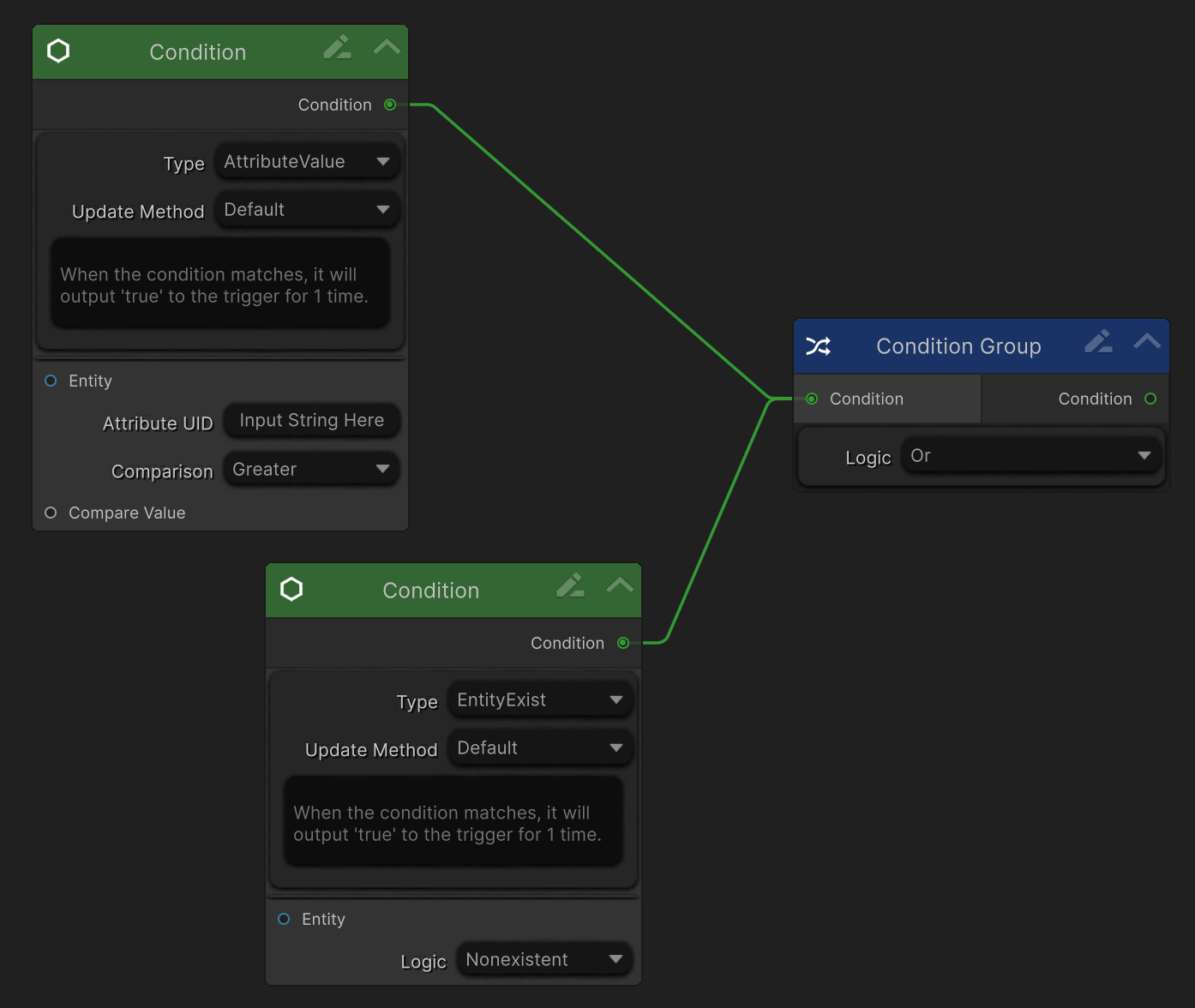
Condition Nodes and Condition Group Nodes are evaluation nodes used to determine logical outcomes within the graph system. They evaluate input data and output a boolean result (True or False) without performing gameplay actions or controlling execution directly.
These nodes form the decision layer of the graph and are commonly used by Trigger Node and Branch Node.
Purpose
Condition Nodes and Condition Group Nodes are used to:
-
Evaluate logical conditions
-
Produce boolean results for decision-making
-
Gate execution or control flow
-
Combine multiple conditions into higher-level logic
They allow complex rules to be expressed in a clear and modular way.
Execution Behavior
-
Condition Nodesare evaluated when their output value is required. -
Each
Condition Nodeevaluates its inputs and outputs either True or False. -
Condition Group Nodesevaluate multipleCondition Nodeinputs and combine their results based on a logical operator. -
These nodes do not modify backend data and have no side effects.
Port Connection Rules
-
Input Ports
Condition Node
Input portsdepend on the specific condition type.Input portscan connect from:These inputs provide the values required to evaluate the condition.
Condition Group Node
-
Accepts multiple
Condition Nodeoutputs as input. -
Input portscan connect only from:Condition Nodes
Each input represents a boolean value to be combined.
-
-
Output Ports
Condition Node
-
Condition Output Port-
Outputs True or False
-
Can connect to:
-
Condition Group Nodes -
Branch Node (condition input ports)
-
Condition Group Node
-
Condition Output Port-
Outputs True or False
-
Can connect to:
-
Condition Group Nodes -
Branch Node (condition input ports)
-
Condition Group Nodescan be nested to form complex logical structures.
-
-
Condition Group Types
Condition Group Nodes support multiple logical operators:
-
AND— Outputs True if all input conditions are True -
OR— Outputs True if at least one input condition is True -
XOR— Outputs True if exactly one input condition is True -
NOR— Outputs True if all input conditions are False
The selected type determines how input conditions are combined.
Common Use Cases
Typical Condition and Condition Group use cases include:
-
Attribute comparisons
-
State or flag checks
-
Cooldown or timing validation
-
Complex rule evaluation
-
Multi-condition gating for
TriggersorBranches
They are frequently used together to express readable and reusable logic.
Design Philosophy
Condition Nodes and Condition Group Nodes are designed to be:
-
Pure (no side effects)
-
Composable (can be chained and nested)
-
Reusable across different graphs
Separating condition evaluation from flow control and execution improves clarity and maintainability.
Summary
-
Condition Nodesevaluate individual conditions -
Condition Group Nodescombine multiple conditions -
Both output boolean results
-
They are used by Trigger Node and Branch Node