Entity Node
Overview
Entity Nodes act as a bridge between Entity instances and the backend data used by the graph system. They provide controlled access to Entity-related information without tightly coupling graph logic to scene objects.
Entity Nodes allow graphs to read Entity context while keeping execution data-driven and backend-focused.
Purpose
Entity Nodes are used to:
-
Access Entity-related data in a controlled way
-
Provide Entity context to Variable Node, Math Node, Branch Node, and Action Node
-
Decouple graph logic from direct Entity references
-
Support both runtime and backend-only execution
They enable graphs to remain flexible while still reacting to Entity state when needed.
Entity Node Types
Player
Represents the player entity.
- Automatically resolves to the entity with UID
playerin the EntityManagerObject.
Dealer
A dynamic reference resolved at runtime.
- Usually represents the damage dealer.
- Set automatically by CombatDamage Component.
- Can also be set manually via:
GraphInstance.SetDealerEntity(Entity entity)
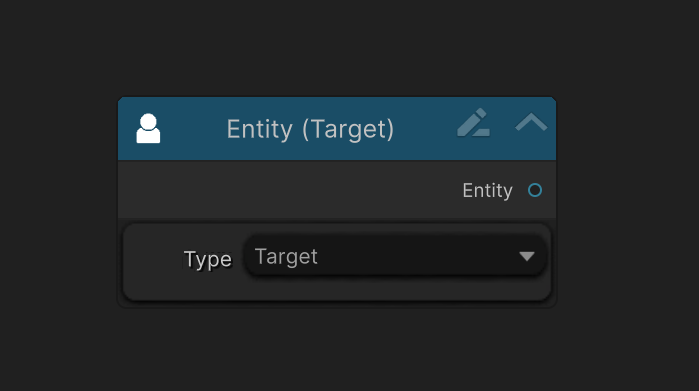
Target
A dynamic reference resolved at runtime.
- Usually represents the damage receiver.
- Managed automatically by CombatDamage Component or OverTimeEffect.
- Can be set manually via:
GraphInstance.SetTargetEntity(Entity entity)
Specified
References a specific Entity by UID.
- Requires a string UID.
- Useful for bosses, NPCs, or world entities.
Instance
Creates a temporary entity owned by the graph instance.
- Exists only during the GraphInstance lifetime.
- Can hold attributes, variables, and effects.
- Ideal for missiles, traps, or temporary logic containers.
Execution Behavior
-
Entity Nodesare evaluated on demand when their output values are required. -
They do not control execution flow.
-
They do not execute gameplay actions by themselves.
Port Connection Rules
Input Ports
- None
Entity Nodedo not expose input ports and represent source of data.
Output Ports
Entity Output Port can connect to:
The output port provides Entity context or Entity-related values to downstream nodes.
Common Use Cases
Typical Entity Node use cases include:
-
Reading Entity-related CustomData
-
Providing source or target Entity context
-
Evaluating conditions based on Entity state
-
Applying actions to a specific Entity
Entity Nodes are often placed near the start of an execution path to establish context.
Design Philosophy
Entity Nodes are designed to expose Entity context without embedding logic.
They:
-
Do not store persistent state
-
Do not own gameplay logic
-
Serve as a clean interface between Entity instances and backend data
This preserves the system’s data-driven architecture while still enabling Entity-aware behavior.
Summary
-
Entity Nodesprovide Entity context -
They do not control flow
-
They do not perform actions