Trigger Node
Overview
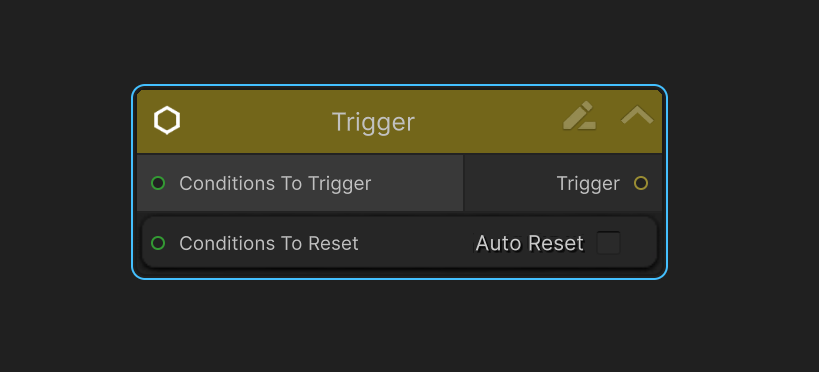
Trigger Nodes are stateful gate nodes used to control when a graph is allowed to execute. They evaluate connected condition nodes and cache their result until explicitly reset.
Trigger Nodes do not execute gameplay logic themselves. Instead, they determine whether connected Root Nodes are allowed to run.
Purpose
Trigger Nodes are used to:
-
Gate graph execution behind one or more conditions
-
Cache condition results across graph calls
-
Control one-time or persistent execution
-
Provide precise control over when
Root Nodesactivate
They are especially useful for implementing cooldowns, state-based triggers, and one-shot logic.
Execution Behavior
-
When the graph is evaluated, the
Trigger Nodechecks all connected condition-type nodes. -
If all connected conditions evaluate to True, the
Trigger Nodebecomes triggered. -
Once triggered, the result is cached and reused on subsequent graph evaluations.
-
The cached result remains valid until the
Trigger Nodeis reset.
Trigger Nodes do not perform actions or control flow directly; they only determine whether execution may proceed.
Port Connection Rules
-
Input Ports
-
Trigger Input Portcan connect from: -
Reset Input Portcan connect from:
-
Trigger conditions determine when the node becomes triggered.
Reset conditions determine when the cached result is cleared.
-
Output Ports
-
Trigger Output Portcan connect only to:Root Nodes
-
The output represents whether the Trigger Node is currently in a triggered state.
Root Node Interaction
-
A
Root Nodemay have multipleTrigger Nodesconnected to it. -
The
Root Nodewill execute only if all connectedTrigger Nodesevaluate to True. -
If any
Trigger Nodeis not triggered, theRoot Nodewill not execute.
This allows multiple independent trigger requirements to gate the same execution logic.
Reset Behavior
Trigger Nodes support two reset mechanisms:
-
Auto Reset
When Auto Reset is enabled:
-
The Trigger Node automatically resets after the connected
Root Nodefinishes execution. -
The trigger conditions must be met again before execution can occur.
-
-
Manual Reset (Condition-Based)
When Auto Reset is disabled:
-
The
Trigger Noderetains its cached result. -
The cached state remains until all connected reset conditions evaluate to True.
-
This allows Trigger Nodes to represent persistent or one-shot states.
Common Use Cases
Typical Trigger Node use cases include:
-
Cooldown-based activation
-
One-time combat or ability triggers
-
State-based execution gates
-
Multi-condition activation logic
-
Persistent unlocks or flags
Trigger Nodes are usually placed before Root Nodes to explicitly define when execution is allowed.
Design Philosophy
Trigger Nodes are designed to be:
-
Stateful (cache evaluation results)
-
Deterministic (clear activation and reset rules)
-
Composable (multiple triggers can gate one Root Node)
By separating trigger logic from execution logic, graphs remain readable, predictable, and flexible.
Summary
-
Trigger NodesgateRoot Nodeexecution -
They cache condition results
-
They only output to
Root Nodes -
They support auto and condition-based reset